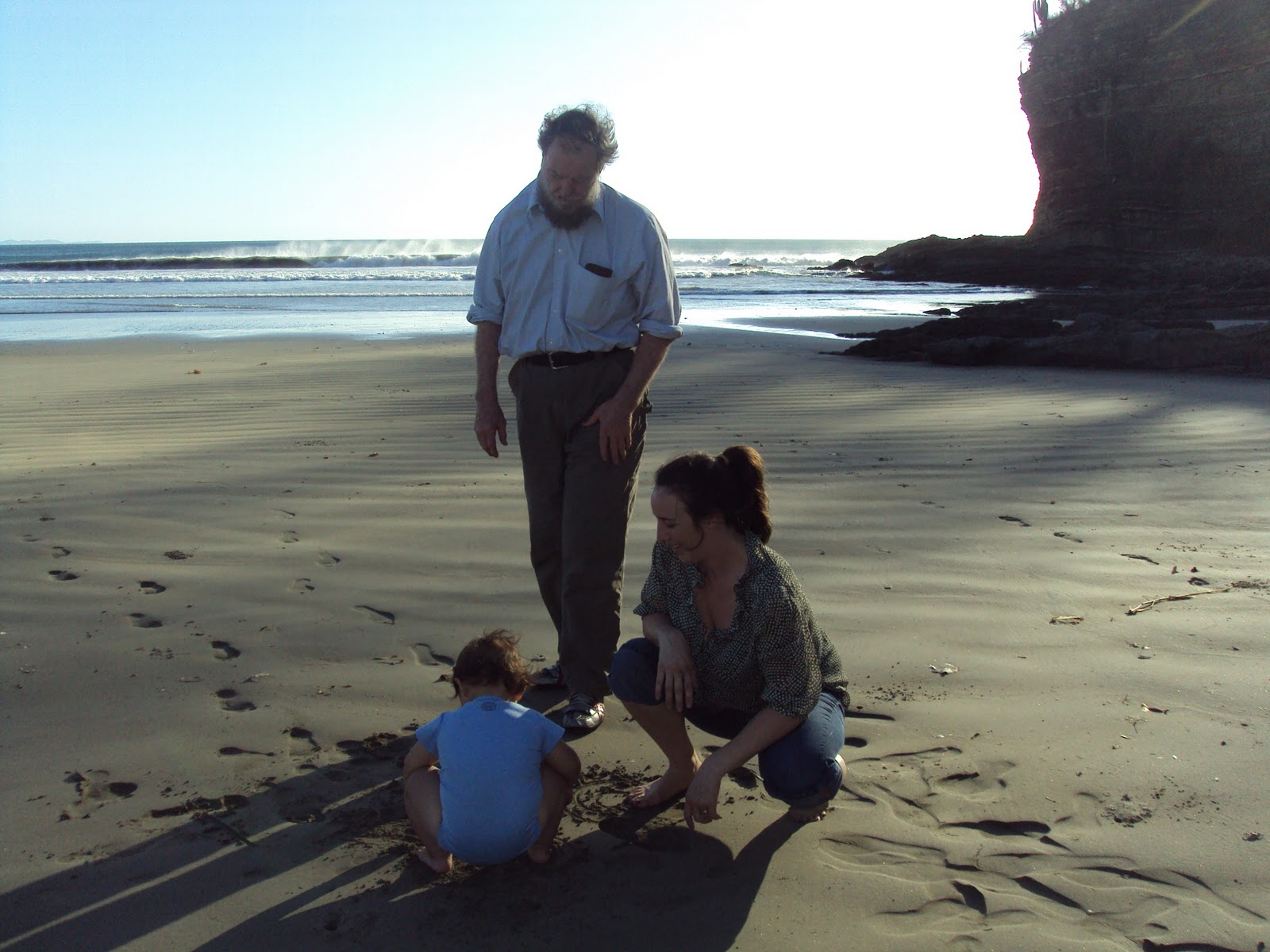
We have been looking at finding a used car to be a little bit more mobile and be able to see more of Nicaragua. My dad came to visit us in the middle of March and it was the perfect push we needed to finally make a decision on a car.
R spent a long time researching cars, looking in ads in the paper, taking the bus to random mechanic's shops and generally looking at every available car in Managua before finding a great deal!
Since we had to pay in cash and our ATM card limits withdraws of $500 a day we had a while to think about it to be sure we wanted to go ahead and purchase. Amazingly our ATM cards did not get blocked which was nice but does have me a little bit worried about the "security features" on our cards.
Our new-to-us-car had to go right in the shop for a few minor things (that we had planned to fix). It was supposed to take 2 days. It took 5. Not surprised.
The day after the car came out of the shop we decided to take an inaugural trip to the beach 3 hours south of Managua in San Juan del Sur. This may have not been the best test of the car.
In the first 5 km we discovered that the windows do not close all the way (we knew they didn't open because of the faulty motors) but the wind whistling through the cab made it clear that getting the window motors fixed should be a higher priority.
We made it safely to San Juan del Sur and then turned of on a dirt road that according to our Lonely Planet approved knowledge indicated would be only a short ride. 18 km later after crossing three streams and testing our four wheel drive up several inclines we pulled into the beautiful Parque Martimo el Coco. We had a small house to ourselves with a fire pit just outside and beach chairs and hammocks; all just 20m from the beach.
Gustavo loved playing in the sand, running in and out of the waves, finding rocks and shells. We saw some amazing sunsets and had an amazing lobster dinner fresh from the next town over cooked over a roaring bonfire that Dad built.
On Sunday when we got the car packed up to leave, the car did not start. The local mechanic fiddled around in the engine for awhile before creating some sort of magical jury-rig bridge to connect whatever it was that was not connecting and preventing the engine from starting. Anyway it started.
Off we went on the 18km, across the three streams and using four wheel drive again, but this time there was a strange new sound. We decided to take a quick trip through the city of San Juan del Sur to take a look around. We didnt stop the car even though the mechanic told that us we could restart the engine "easily" by connecting the two separated metal pieces again. It sounded totally safe. As did driving a car that cant be turned off. So we continued on!
Now, however, the car would not go faster than 60. Kilometers per hour. Well really it only went down hill from there and by downhill I mean the opposite of picking up speed -- we got progressively slower... and slower .. and slower. At one point we got passed by a moto taxi. We did manage to get all the way to Diriomba -- which is luckily only 40 minutes from Managua. However at that point the wheels stopped turning and it became clear between that and the green transmission fluid leaking out of the car that the transmission was no more. R & Dad pushed the car to the side of the road, where we discovered that we also had a flat tire.
After assessing this situation we decided that R would take a moto taxi to the nearest town, find a taxi and come back to get us. This was a fine plan, until R got to the town and found out that there were no taxis. After conferring on the phone we decided that I would pack up all of the beach things, get Dad, G, myself and the beach gear in a mototaxi and go meet R. We had three canvas bags,a diaper bag, our food bag, a stroller, and Dad's duffle bag.
This is how big a mototaxi is: (not very.)
The first moto taxi I flagged down decided it would be no problem to get everything into his moto taxi and take us to the next town, but when he heard our plan he offered to take us further to the next town where there was sure to be a taxi. This sounded reasonable because the next town is bigger.
Several other moto taxis seeing the excitement decided to also stop to check out what was going on. Everyone was willing to help change the tire and send us on our way, but there was some difficulty in understanding that the flat tire was the smallest of the three problems until the local mechanic drove by and, drawn by the excitement, also decided to check things out.He quickly determined that our truck was not going anywhere.
He in a matter of minutes had relieved me of the keys of the car and was ready to head on his way to get his town truck almost without giving me his name and number. Luckily he also remembered that there was in fact a taxi in town before he took off. My moto taxi friend offered to drive us by the shop so I could see where we would be leaving the car. At this point we also remembered that perhaps R was on his way to a totally different city. Luckily he still had not been able to find a bus or a taxi so we were able to stop him before he got any further than where he had been an hour previously.
Our moto taxi friend drove us to the house of the taxi driver who quoted his price which I weakly negotiated down asking him if that was his best price (what is your negotiating position when you have a moto taxi filled with bags, your Dad and Son and husband is somewhere else is a city you don't know?). So we put all our bags in his car, he drove off in a totally different direction towards the gas station while we went in search of R who was, not surprisingly, making friends in the town square. Luckily the taxi and our bags showed up shortly after that and we made it home to Managua all in one piece though one car lighter.
Even more surprising the mechanic repaired the car in two days and delivered it to our house.
Les surprisingly, Dad has been somewhat reluctant to make any long trips in the car, though we were able to make it to Leon and Granada without any problems though the windows still don't go up or down. Did I mention it has been 35 degrees Celsius all this week?
Monday, March 28, 2011
Sunday, March 6, 2011
Sunday, February 27, 2011
What do I do?
I realized that I haven't really explained what I do, or what this job is that motivated us to move to Nicaragua. The short explanation is that I am the country director for an orphanage reform project.
The longer answer (get ready for me to dork out on this) is that we are a small NGO that has been working in Nicaragua for about 5 years funded by private donations. This year we were awarded funding from the Inter American Development Bank to continue our work, under the orphanage reform effort headed by the Ministry of the Family here in Nicaragua with whom we have a memorandum of understanding to implement our methodology in all of the Protection Centers (orphanages that are dedicated to abandon, abused or neglected children).
Our methodology is an evidenced based approach to improving the quality of life for these children by improving the quality of care given to them. We emphasize small groups of children with 1-3 primary care givers who consistently work with the children. The continuity of care (not moving children around, not moving caregivers around) is key to for children, especially in the 0-6 year range, to develop appropriately socially, emotionally, cognitively and physically (there is a really interesting study in Russia that proves this last point). Also essential is providing for freedom of movement -- not leaving children in cribs all day because it is easier for their caregivers. We advocate for mixed age groups, and maintaining of sibling groups.
A lot of our work focuses on how to make the time that caregivers can spend on one child really count -- making a diaper change an opportunity to connect with the child, communicate with them, encourage language development, develop a relationship.
We are currently working with 5 orphanages all in Managua, but hope to expand outside of the city within the next year and hope to eventually work with all 83 orphanages nation wide.
We begin by assessing the orphanage -- it's structure physically and logistically, the staff, and the children (using several different development assessment tools). Then we sit down with the directors and the technical staff of the orphanages to make a work plan -- in theory this should be easy because we have already presented to them our methodology and the Ministry has given us the go ahead to work with them, but in reality this is very complicated as I guess change always can be. Once the work plan is done then we get to work!
We provide training first to the directors and technical staff on the basics of our methodology, then we provide training to the caregivers (and anyone else who has direct contact with the children). The Caregiver training actually began this past week! The Caregiver training is given over 9 months -- we provide one lesson a month (the same lesson given three consecutive days so that all of the shifts can be covered) followed by direct mentoring of the caregivers during their work shifts by our staff. We have a course on Early Childhood Development that we also intend to provide to our local staff and the directors and technical staff as well Ministry staff and any other interested parties. The exciting news about this is that I'm working to get it accepted as a Post Graduate Certificate at a local very respected University.
We make structural improvements such as putting in child gates so that children can move freely in safe areas, creating different kinds of areas (soft play areas, elevated areas, quiet areas) as opposed to one giant room, and play areas (like a sandbox!). We also provide toys and books that encourage learning and age appropriate development and have worked with staff to make appropriate home made toys as well (ej: take a clear disposable water bottle, even better if it has a texture on it. Fill it half with oil - best is baby oil but cooking oil works fine - and half with colored water. Add some plastic or shiny confetti. Glue gun the lid on. = hours of fun).
The possibility for impact on the lives of the children in these Protection Centers is extreme. When we first began working in one of the orphanages, caregivers identified children only by the hospital style name bands they had on their wrists and children were in wards of 15 or more. There still is a lot of improvement to be done in the orphanage we originally began working with, as well as the other 4, but I am so excited about the possibilities of what we can do. If succeed in successfully working with the Ministry to implement our methodology Nicaragua would actually be a model orphanage system.
All this is not to say that I or even our NGO is in favor of orphanages, far from it, but the reality is that there are no large scale efforts being made to reform the orphanage system. Many large international organizations work with orphans but not orphanages with the idea that orphanages are not good places for children to grow up. It's true they are not -- but it doesn't mean that they can't be made better for the children that have no choice but to grow up there.
Further reading if you are interested:
www.wholechild.org
http://www.ocd.pitt.edu/Files/PDF/managuaorphanage.pdf
http://www.ocd.pitt.edu/Files/Publications/The%20Effects%20of%20Early%20Social-Emotional.pdf
http://www.aipl.org/
The longer answer (get ready for me to dork out on this) is that we are a small NGO that has been working in Nicaragua for about 5 years funded by private donations. This year we were awarded funding from the Inter American Development Bank to continue our work, under the orphanage reform effort headed by the Ministry of the Family here in Nicaragua with whom we have a memorandum of understanding to implement our methodology in all of the Protection Centers (orphanages that are dedicated to abandon, abused or neglected children).
Our methodology is an evidenced based approach to improving the quality of life for these children by improving the quality of care given to them. We emphasize small groups of children with 1-3 primary care givers who consistently work with the children. The continuity of care (not moving children around, not moving caregivers around) is key to for children, especially in the 0-6 year range, to develop appropriately socially, emotionally, cognitively and physically (there is a really interesting study in Russia that proves this last point). Also essential is providing for freedom of movement -- not leaving children in cribs all day because it is easier for their caregivers. We advocate for mixed age groups, and maintaining of sibling groups.
A lot of our work focuses on how to make the time that caregivers can spend on one child really count -- making a diaper change an opportunity to connect with the child, communicate with them, encourage language development, develop a relationship.
We are currently working with 5 orphanages all in Managua, but hope to expand outside of the city within the next year and hope to eventually work with all 83 orphanages nation wide.
We begin by assessing the orphanage -- it's structure physically and logistically, the staff, and the children (using several different development assessment tools). Then we sit down with the directors and the technical staff of the orphanages to make a work plan -- in theory this should be easy because we have already presented to them our methodology and the Ministry has given us the go ahead to work with them, but in reality this is very complicated as I guess change always can be. Once the work plan is done then we get to work!
We provide training first to the directors and technical staff on the basics of our methodology, then we provide training to the caregivers (and anyone else who has direct contact with the children). The Caregiver training actually began this past week! The Caregiver training is given over 9 months -- we provide one lesson a month (the same lesson given three consecutive days so that all of the shifts can be covered) followed by direct mentoring of the caregivers during their work shifts by our staff. We have a course on Early Childhood Development that we also intend to provide to our local staff and the directors and technical staff as well Ministry staff and any other interested parties. The exciting news about this is that I'm working to get it accepted as a Post Graduate Certificate at a local very respected University.
We make structural improvements such as putting in child gates so that children can move freely in safe areas, creating different kinds of areas (soft play areas, elevated areas, quiet areas) as opposed to one giant room, and play areas (like a sandbox!). We also provide toys and books that encourage learning and age appropriate development and have worked with staff to make appropriate home made toys as well (ej: take a clear disposable water bottle, even better if it has a texture on it. Fill it half with oil - best is baby oil but cooking oil works fine - and half with colored water. Add some plastic or shiny confetti. Glue gun the lid on. = hours of fun).
The possibility for impact on the lives of the children in these Protection Centers is extreme. When we first began working in one of the orphanages, caregivers identified children only by the hospital style name bands they had on their wrists and children were in wards of 15 or more. There still is a lot of improvement to be done in the orphanage we originally began working with, as well as the other 4, but I am so excited about the possibilities of what we can do. If succeed in successfully working with the Ministry to implement our methodology Nicaragua would actually be a model orphanage system.
All this is not to say that I or even our NGO is in favor of orphanages, far from it, but the reality is that there are no large scale efforts being made to reform the orphanage system. Many large international organizations work with orphans but not orphanages with the idea that orphanages are not good places for children to grow up. It's true they are not -- but it doesn't mean that they can't be made better for the children that have no choice but to grow up there.
Further reading if you are interested:
www.wholechild.org
http://www.ocd.pitt.edu/Files/PDF/managuaorphanage.pdf
http://www.ocd.pitt.edu/Files/Publications/The%20Effects%20of%20Early%20Social-Emotional.pdf
http://www.aipl.org/
We have a real bed!!
Furniture Update: After out inflatable mattress died, we very carefully choose the busiest possible moment of traffic in Managua (Friday evening, during the beginning of the annual motorcycle rally and ride from Managua to San Juan del Sur) to strap the box springs and mattress of a bed from my work's guest house to the top of our office car (a sedan) ... with my jump rope ... And by strap down, I mean I held one side of the jump rope and my co-worker held the other side of the jump rope while Gustavo sat in the middle saying "Vroom Vroom" to all of the motorcycles as we drove 5km through packed traffic and hundreds of motorcycles.
What is most perplexing (especially if you have read my earlier post about driving in Managua), we passed 8 policemen who did not bat an eye. Also there was no more honking than usual. So strange....
Sunday, February 20, 2011
No furniture
So we found out we were moving to Nicaragua December 8th, and moved here less than a month later on January 4th. It was fast and furious -- I worked up until December 23rd, had my family to our house for Christmas, spent New Years at my mom's and in the meantime found renters and a management company, sold a bunch of stuff on Craig's list, donated some stuff, packed stuff for storage, had some work done on the house, found international movers and had them come pack everything off for Nicaragua. Luckily I had a lot of help of some amazing friends, my goddaughter Jorgelina and my mom.
The international movers came to pack and ship things on December 30th. Today is February 20th and we are still waiting for our shipment.
Supposedly all of our things were supposed to be shipped January 29th with an estimated arrival date in Nicaragua of February 5th. Note I say estimated.....
When I called this week on the 15th the movers tried to tell me that perhaps there hadn't been any ships that left from my port of origin. Really? No ships at all out of Baltimore? I was skeptical... When they looked into is they discovered that apparently there was an overbooking of items getting shipped from Baltimore to Nicaragua (really? Is that really a high traffic shipping route?). So the new estimated shipping date in March 5th to arrive in country March 11th.
Wow.
So while it seemed that maybe bringing four suitcases packed as full as full can be was silly, it was in fact a great idea.
See below for what our house looks like. We broke down and bought patio furniture so that we have somewhere to sit other than the floor.
Really we are hoping that our furniture gets here before Gustavo destroys his travel crib (it's dark but hopefully you can see):
Luckily we love the house and are really enjoying it! But we are looking forward to not sleeping on inflatable mattresses....
The international movers came to pack and ship things on December 30th. Today is February 20th and we are still waiting for our shipment.
Supposedly all of our things were supposed to be shipped January 29th with an estimated arrival date in Nicaragua of February 5th. Note I say estimated.....
When I called this week on the 15th the movers tried to tell me that perhaps there hadn't been any ships that left from my port of origin. Really? No ships at all out of Baltimore? I was skeptical... When they looked into is they discovered that apparently there was an overbooking of items getting shipped from Baltimore to Nicaragua (really? Is that really a high traffic shipping route?). So the new estimated shipping date in March 5th to arrive in country March 11th.
Wow.
So while it seemed that maybe bringing four suitcases packed as full as full can be was silly, it was in fact a great idea.
See below for what our house looks like. We broke down and bought patio furniture so that we have somewhere to sit other than the floor.
Really we are hoping that our furniture gets here before Gustavo destroys his travel crib (it's dark but hopefully you can see):
Luckily we love the house and are really enjoying it! But we are looking forward to not sleeping on inflatable mattresses....
Friday, February 11, 2011
Adeventures withthe Black Market
This week my computer was stolen -- my work computer that has everything I have been working on for the past month. We are a small NGO and I have been creating a lot of documents from scratch -- contracts, procedures, budget templates, technical one pagers and technical outlines, etc, etc, etc. Luckily I am apparently a prolific emailer and much of this information is accessible on my email. Unfortunately the work plan for all of the orphanages is not.
I parked the office car outside of the fanciest supermarket in Managua (which is on my way home from work), went inside for 20 minutes, came out and POOF no more computer. There were two security guards right there who "didn't see anything at all". Riiiight.
I called my office manager who is my go-to-lady, she sent her husband. We called the police and Rafael & "Juan Carlos" went to make the report. Rafael was pretty fired up about the computer being lifted from the car right in front of the security guards.
He must have made quite an impression because when i went back in the morning they told me "Your husband spoke to us very sternly". Yes, yes I imagine he did.
So these things happen, anywhere really. And the funny thing is in Baltimore I was so careful about never leaving anything visible ever in the car, and here I just didn't think about it. So I do feel safe, maybe too safe.
I told the security guards (and their boss, and the owner of the super market) that I bet that someone paid the guards and my computer is already being sold. I also told them that this was a shame because in stealing from me, they are impacting a program that works with abandoned and abused children. I may have laid on a little bit of a guilt trip. And I offered a reward for the computer -- return it to our church, if it is in fact the right computer, no questions asked I will pay "the ransom".
Yesterday I went to the police office downtown in Mercado Oriental to find out if there has been any progress. Shockingly, no there has not. I asked where are computers usually sold when they are stolen to which the police lady told me -- "Oh I can't go there, they know I am Police". Yes I said, but I can go!
I should explain the Mercado Oriental -- it is 26 square city blocks and is supposedly the biggest market in all of Central America. You can buy anything there. It also the home of the black market and organzied crime in Nicaragua.
Here is what Lonely Planet says about Mercado Oriental (Mom: skip this pragraph)
"Stash your cash in a couple of places (sock, bra) and try to find a local guide for Central America's largest market and scariest shopping experience. But it's so cheap, and probably the only place in town with live hand grenades…"
The State Department website says (Mom skip this one too)
"Gang activity also is increasing, though not at levels found in neighboring Central American countries. Pick-pocketing and occasional armed robberies occur on crowded buses, at bus stops and in open markets like the Oriental and Huembes Markets."
but it also says about Nicaragua in general:
"Do not leave valuables inside parked vehicles. Recently, several U.S citizens have reported vehicle break-ins outside of gasoline stations and restaurants"
Sighhhh. Good point.
Anyway, the police lady directed me to a mere two blocks from the police station inside the Market, where I began to pretend I wanted to buy a computer. (Mom, don't worry -- I didnt carry anything with me at all and a lady from my office went with me) Strangely I was only interested in a Dell, model ... oh gosh, what was that model I heard about? Yes, a Vostro. I made some friends who were very excited to sell me a computer, but none had a Dell.
So at this point I have put out the word (with my daily stops at the Super market) that I really need this computer and am willing to pay to get it back, but I think it's gone.
I'll leave you with some pictures of el Oriental:
These guys are trying to give their horse some beer. It is 11am in the morning.
WANTED:
I parked the office car outside of the fanciest supermarket in Managua (which is on my way home from work), went inside for 20 minutes, came out and POOF no more computer. There were two security guards right there who "didn't see anything at all". Riiiight.
I called my office manager who is my go-to-lady, she sent her husband. We called the police and Rafael & "Juan Carlos" went to make the report. Rafael was pretty fired up about the computer being lifted from the car right in front of the security guards.
He must have made quite an impression because when i went back in the morning they told me "Your husband spoke to us very sternly". Yes, yes I imagine he did.
So these things happen, anywhere really. And the funny thing is in Baltimore I was so careful about never leaving anything visible ever in the car, and here I just didn't think about it. So I do feel safe, maybe too safe.
I told the security guards (and their boss, and the owner of the super market) that I bet that someone paid the guards and my computer is already being sold. I also told them that this was a shame because in stealing from me, they are impacting a program that works with abandoned and abused children. I may have laid on a little bit of a guilt trip. And I offered a reward for the computer -- return it to our church, if it is in fact the right computer, no questions asked I will pay "the ransom".
Yesterday I went to the police office downtown in Mercado Oriental to find out if there has been any progress. Shockingly, no there has not. I asked where are computers usually sold when they are stolen to which the police lady told me -- "Oh I can't go there, they know I am Police". Yes I said, but I can go!
I should explain the Mercado Oriental -- it is 26 square city blocks and is supposedly the biggest market in all of Central America. You can buy anything there. It also the home of the black market and organzied crime in Nicaragua.
Here is what Lonely Planet says about Mercado Oriental (Mom: skip this pragraph)
"Stash your cash in a couple of places (sock, bra) and try to find a local guide for Central America's largest market and scariest shopping experience. But it's so cheap, and probably the only place in town with live hand grenades…"
The State Department website says (Mom skip this one too)
"Gang activity also is increasing, though not at levels found in neighboring Central American countries. Pick-pocketing and occasional armed robberies occur on crowded buses, at bus stops and in open markets like the Oriental and Huembes Markets."
but it also says about Nicaragua in general:
"Do not leave valuables inside parked vehicles. Recently, several U.S citizens have reported vehicle break-ins outside of gasoline stations and restaurants"
Sighhhh. Good point.
Anyway, the police lady directed me to a mere two blocks from the police station inside the Market, where I began to pretend I wanted to buy a computer. (Mom, don't worry -- I didnt carry anything with me at all and a lady from my office went with me) Strangely I was only interested in a Dell, model ... oh gosh, what was that model I heard about? Yes, a Vostro. I made some friends who were very excited to sell me a computer, but none had a Dell.
So at this point I have put out the word (with my daily stops at the Super market) that I really need this computer and am willing to pay to get it back, but I think it's gone.
I'll leave you with some pictures of el Oriental:
These guys are trying to give their horse some beer. It is 11am in the morning.
WANTED:
Saturday, February 5, 2011
Pump up your Saturday
G loves to dance. He is transfixed by any music from marimba, to bachata, to country, to alternative, to cheesy Jason Mraz, to drum beats, to some rocking 80's tunes.
And sometimes he likes to just dance all on his own!
Subscribe to:
Posts (Atom)